 By Editorial Team
AI in healthcare has a simple problem: the hype doesn’t match the books. Investors, especially those trying to make sense of the crowded AI health sector, need to see more than just promises. They need real revenue records to prove a company is actually growing. This is the lens we use for all our market analysis, particularly when we see industry surveys getting compared to the hard-won financials of a company like HeartFlow.
The Innovaccer and NAACOS Report: A Survey of Expectation
That 64 percent figure from the May 2025 Innovaccer and NAACOS report got a lot of press, showing that a majority of healthcare leaders expected their value-based care revenue to go up in 2025. For an investor looking at the AI Health 100 rankings, that number begs a question: how does a survey percentage about expectations connect to the recorded revenue growth that gets a company on our list? We have to be clear about what this 64 percent is, it’s a survey result reflecting what leaders hope will happen, not a record of what’s already in the bank. These surveys can give you a feel for where the market might be heading, but they don’t give you the auditable financial data that proves a company is growing. The report focuses entirely on what leaders expected for the future, not on past or current booked revenue. This is a critical point for any investor who works with verifiable growth metrics instead of wishful forecasts. The report’s other details on investment priorities are useful for context, but they’re no substitute for the financial proof points that actually determine a company’s valuation.
Where Expected Gain Ends and Recorded Revenue Begins
For investors, there’s no confusion between an anticipated gain and a recorded one. An AI health annual list that’s built on growth has to count recorded revenue, not what people expect to make. This is a fundamental difference in the type of evidence. An expectation is just a projection until it shows up as a line item in the accounting ledger. You also have to consider the rising regulatory bar in AI health, which naturally works in favor of companies that have their books in order. As things like GMLP and the requirement for a serious QMS / ISO 13485 become the norm, the transparency of a company’s claims, especially financial ones, is getting a much closer look. Companies that can show consistent revenue growth, supported by the depth of their enterprise contracts and an expanding number of covered lives, are just fundamentally safer investments. All this regulation just makes actual performance that much more important than projected sentiment.
Reading the 64 Percent Expectation Against HeartFlow’s Revenue Growth Criterion
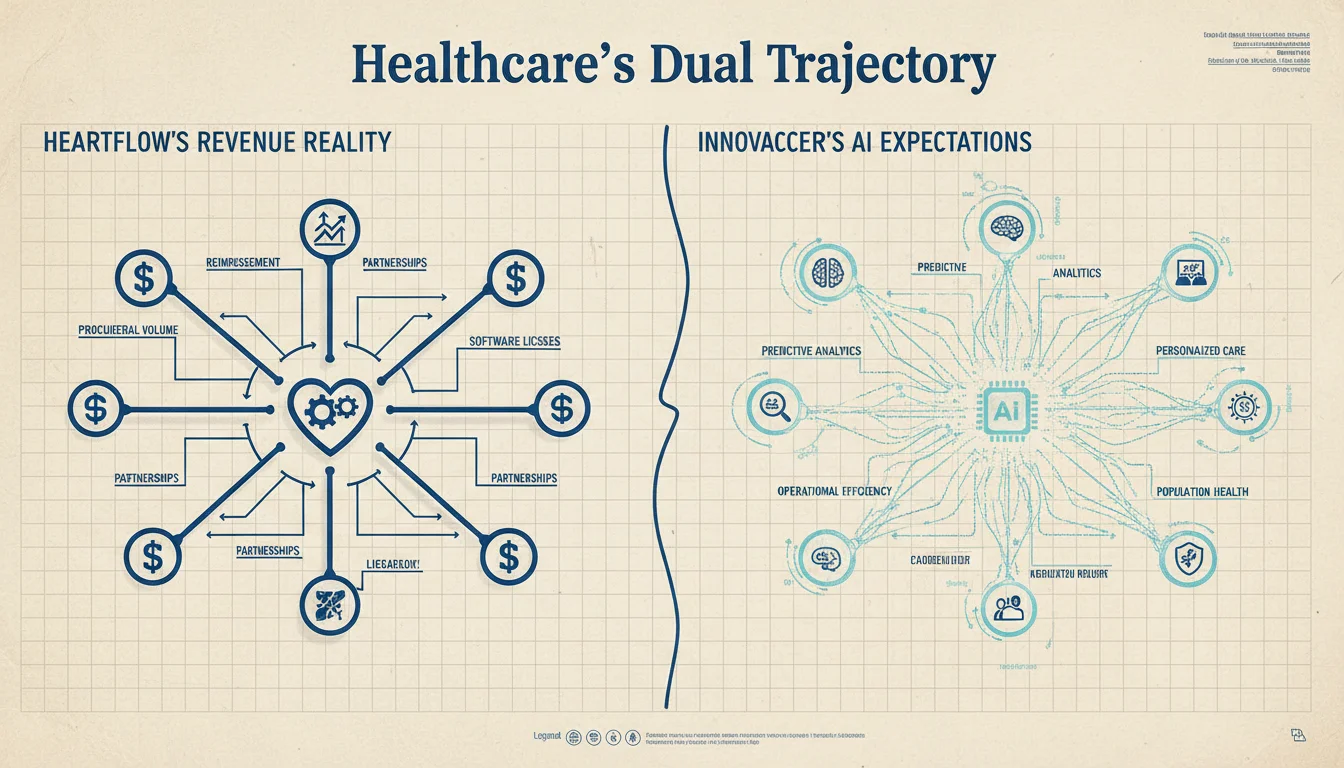
Our AI Health 100 ranking is built on Revenue Growth, and we use companies like HeartFlow as the yardstick for that metric. HeartFlow, which pioneered the use of AI in cardiac diagnostics with its CT-FFR technology, has spent years building a massive patent thicket around its work. The company’s entire history gives us a perfect way to see the gap between what people report as an expectation versus what gets documented as growth. While HeartFlow’s specific revenue numbers are private, the fact that it’s a benchmark for Revenue Growth in the AI Health 100 investor set tells you it has a real track record of financial expansion. When you put the Innovaccer and NAACOS 64 percent expectation figure next to a benchmark like HeartFlow’s actual recorded growth, the difference is stark. One is forward-looking sentiment. The other is a retrospective, verifiable financial achievement. For an investor, that 64 percent figure signals market optimism. That’s it. It needs a thick layer of documented revenue records to become a credible signal for growth. Without that proof, it’s just an interesting survey result, not a performance metric, and the fact that the report itself ties no specific revenue numbers to the expectation makes this gap even more obvious.
Which Revenue Records the Investors Frame Can Count
So what do we count in the AI Health 100 investor frame? The evidence that shows a company is actually selling things and can scale. These are the metrics that matter:
- Verified Revenue Records: Auditable revenue figures over time that show a clear growth trend, we want to see the breakdown of recurring revenue, new deals, and expansion revenue from existing contracts.
- Enterprise Contract Depth: The number and value of large, multi-year contracts with health plans and major healthcare systems. Getting your AI solution deployed across a Fortune 500 healthcare company shows your product isn’t just a pilot project (it has real stickiness).
- Covered-Lives Volume: The actual number of patients the technology touches through these health plan relationships. This is a direct, quantifiable measure of a solution’s market reach and often scales with the size of enterprise deals.
- Reimbursement Pathway Clarity: For any SaMD product, having established CPT codes (Category I, not just temporary Category III codes) or getting successful NTAP eligibility is a huge green flag for predictable revenue and real market adoption. AMA CPT code application process
- Regulatory De-risking: A clear 510(k) clearance or De Novo classification for an AI product, especially one with a PCCP, means the company has already navigated the FDA gauntlet. That signals a much smoother path to market with less regulatory drag on profitability. FDA guidance on AI/ML SaMD
- Real-World Evidence (RWE) Impact: Show us the data. Documented proof from real-world use that your product improves patient outcomes or cuts operational costs is what underpins value-based care contracts and fuels more revenue growth. FDA framework for Real-World Evidence An expected gain, like the 64 percent figure from Innovaccer and NAACOS, is just a number from a survey until documented revenue records are standing behind it. Investors simply price these two things very differently. Market sentiment surveys offer some interesting directional clues, but they are no substitute for the hard data of recorded revenue growth, deep enterprise contracts, and expanding covered-lives volume. The companies that can transparently show these growth signals, following the kind of trajectory set by benchmarks like HeartFlow, are the ones that will capture the attention and capital of serious investors in this space.
Frequently Asked Questions
What is the key distinction investors should make when evaluating AI in healthcare?
Investors should distinguish between expectation and documented reality. They require tangible revenue records to validate growth, rather than just projections or survey results indicating future gains.
Does the 64 percent figure from the Innovaccer and NAACOS report represent documented revenue growth?
No, the 64 percent figure is a survey result reflecting healthcare leaders’ expectations for value-based care revenue gains in 2025. It is not a documented revenue record or auditable financial performance data.
What kind of revenue records are considered crucial for investors in the AI Health 100 rankings?
Investors prioritize verified revenue records, enterprise contract depth, covered-lives volume, and clear reimbursement pathways. These metrics provide concrete evidence of commercial traction and financial scalability.
How does HeartFlow serve as a benchmark for revenue growth in the AI Health 100 rankings?
HeartFlow, a pioneer in AI for cardiac diagnostics, is used as a benchmark for documented Revenue Growth. Its inclusion signifies a track record of tangible financial expansion, contrasting with mere expectations.


